Module 2: Coaching Disc Golf
What’s in this module:
- Putting, backhand driving, forehand, and X-step techniques
- The ADG 5-Lesson Plan: structure, activities, and coaching tips
- Safety in open environments: managing disc golf-specific risks in shared-use spaces
- Delivering disc golf in schools: working with teachers, session structure, Sporting Schools
- Safeguarding, compliance, and risk management: WWCC, SIA training, first aid, responding to harm
Learning outcomes
On completion of this module, you will be able to:
- Demonstrate knowledge of fundamental putting, driving, and forehand techniques sufficient to teach beginners
- Plan and deliver a disc golf session using the ADG 5-Lesson Plan
- Identify and manage common safety risks when delivering disc golf in open or shared-use environments
- Describe how to deliver disc golf within a school setting, including working with classroom teachers and structuring sessions for HPE
- Explain your obligations under Working with Children Check legislation and SIA safeguarding requirements
- Describe your responsibilities for responding to a disclosure or suspicion of harm
Quiz: 15 questions (80% to pass and unlock Module 3). Hit Next to start with putting technique.
Techniques to Teach
You don’t need to be an expert thrower to coach disc golf. Focus on demonstrating correct form and encouraging participants to practise. The three core techniques are:
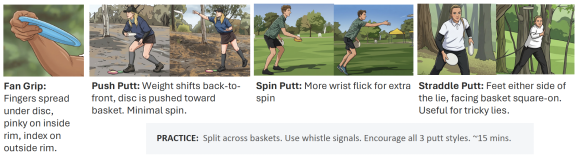
1. The Putt (Short, Accurate Throws)
- Grip – Fan Grip: Fan your fingers under the disc. Little finger against the inside rim, index finger on the outside rim.
- Stance: Face the basket with good balance. Head towards target. Back leg provides power.
- Action: Shift weight to back foot with disc towards body. Transfer weight to front foot while pushing disc towards basket, springing off back foot.
- Finish: Point hand towards basket – like shaking hands with it. No body rotation.
2. The Backhand Drive (Long-Distance Throws)
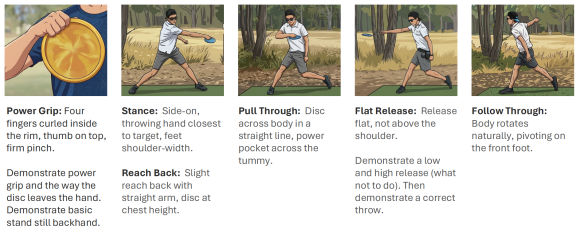
- Grip – Power Grip: Press four fingers inside the rim wall. Thumb on top, pinching firmly.
- Stance: Stand side-on to target, throwing hand closest to target. Feet shoulder-width apart.
- Action: Reach back in a straight line. Pull disc through chest while transferring weight to front foot. Release with a wrist flick for spin.
- Finish: Follow through, body swings around pivoting on front foot.
Troubleshooting: Disc going up = nose-up release (keep elbow in line with chest). Disc diving = nose-down release.
3. The Forehand / Sidearm
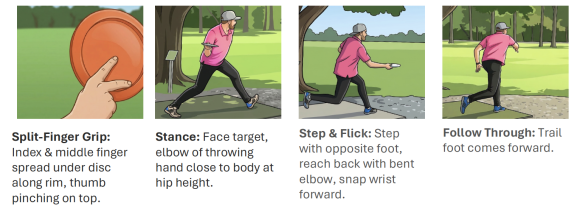
- Grip – Split Finger Grip: Index and middle fingers flat under disc against inside rim, spread apart. Thumb pinches top.
- Stance: Face throw direction. Elbow close to body at hip.
- Action: Step forward with opposite foot, reach back with bent elbow. Transfer weight forward, flick wrist to release.
- Finish: Follow through with back foot coming forward.
4. The X-Step (Advanced Footwork)
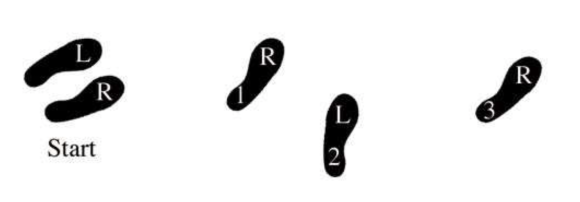
Adds power to a backhand drive. Start side-on, dominant hand forward. Step to side with front foot, cross back foot behind and slightly ahead, step again with front foot transferring weight. Practise slowly before adding a disc.
The ADG 5-Lesson Plan
Australian Disc Golf has developed a purpose-built 5-lesson plan that serves as an excellent foundation for any disc golf program. While it was originally designed for schools, the activities work brilliantly in any setting – come-and-try days, club sessions, holiday programs, or disability sport.
| Lesson | Focus | Activities | Skills |
|---|---|---|---|
| 1 | Introduction | Heads or Tails, Gyronaughts & Crosses, CTP | Accuracy, distance, basic rules |
| 2 | Putting Focus | Rob the Nest, Cone Guts, Hot Shots, Ring of Fire (bonus) | Fan grip, putting technique |
| 3 | Driving Focus | OB Island Tag, Driving Range, Disc Golf Baseball, Ace Race (bonus) | Power grip, backhand drive |
| 4 | More Skills | X-Step, Mando Mania, Drive for Show Putt for Dough | Forehand, X-step, combined skills |
| 5 | Play a Round | Play 9/18 holes at a course or object golf | Scoring, shot selection, etiquette |
Each lesson includes detailed setup instructions, equipment lists, gameplay rules, safety notes, and diagrams. Read through the full 5-Lesson Plan document thoroughly as part of this module.
Safety in Open Environments
Unlike most sports, disc golf is typically played in open public spaces shared with walkers, cyclists, dogs, and other park users. This creates safety dynamics that don’t exist in a fenced oval or gymnasium. As a coach, managing these is one of your most important responsibilities.
Throwing safety
- Never throw when anyone is in the line of play. This includes bystanders, other park users, and animals. Wait for the fairway to clear completely.
- Use spotters for blind throws where you can’t see the landing area. Position a helper ahead to confirm the area is clear before anyone throws.
- Establish a clear signal system, such as a whistle blast or a call of “clear!”, so your group knows when it’s safe to throw and when to stop.
- If a disc is heading towards someone, call out immediately. The standard warning is “fore!” or simply “watch out!”
Course and venue awareness
- Walk the area before your session. Note where foot traffic flows, where paths cross your throwing lines, where playgrounds or picnic areas are nearby.
- Set up activities away from high-traffic areas. If a particular hole or station has a throwing line that crosses a path, reposition it or skip it.
- Be aware of other park users’ right of way. Disc golf happens in their space too. If someone walks through your session area, pause, wait, and be friendly about it.
Temporary course setup
If you’re setting up a temporary course on a school oval, park, or open field:
- Space holes so that throwing lines don’t intersect. Groups on adjacent holes should never be throwing towards each other.
- Leave a buffer zone between your furthest target and any boundary fence, road, or public area.
- Use visible markers (cones, flags, bright tape) so participants and bystanders can see where throwing zones are.
- For school settings, keep the layout well within the oval or grounds. Discs leaving the school boundary create a safety and supervision issue.
Disc selection for safety
In introductory and group settings, use putters and midranges only. These are slower, lighter, and cause far less harm if they hit someone than a distance driver thrown at full power. For younger children, use lighter discs (150–165g). This is a safety decision as much as a coaching one.
Weather and conditions
- Heat and sun: Brief participants on sun safety. Ensure water is accessible. Schedule breaks in shade. In extreme heat, shorten or cancel the session.
- Wet conditions: Wet discs are slippery and can fly unpredictably. Wet grass is a slip hazard. Consider whether conditions are safe enough to continue.
- Lightning: If you see lightning or hear thunder, stop the session immediately and move the group to shelter. Do not resume until at least 30 minutes after the last lightning or thunder.
Delivering Disc Golf in Schools
Schools are one of the best pathways for growing disc golf in Australia. Several schools around the country have installed permanent disc golf courses on their grounds, and many more have used the ADG 5-Lesson Plan to deliver disc golf as part of their HPE program with nothing more than a bag of discs and some cones. Whether you’re a teacher adding disc golf to your curriculum or an external coach working with a school, this section covers what you need to know.
Working within the school environment
- Session length: A standard HPE lesson is typically 45–60 minutes. This is enough for a warm-up activity, one or two main activities from the 5-Lesson Plan, and a short wrap-up. Don’t try to cram in too much. One well-run activity beats three rushed ones.
- Class sizes: You may have 25–30 students. Plan activities that keep everyone active at the same time. Avoid single-line queues where students stand waiting for a turn. Multiple throwing stations, team-based games from the lesson plan, and rotation formats all help.
- The classroom teacher: If you’re an external coach, the classroom teacher should remain present and is the primary behaviour manager. Introduce yourself, ask about any students with specific needs, and check whether the school has a behaviour management framework you should follow. Work with them, not around them.
- School-specific compliance: Sign in at reception. Follow the school’s visitor, photo, and media policies. Ask about allergy and medical action plans for students in the group. Know who to report to if something goes wrong. This is usually the classroom teacher or duty coordinator.
Setting up on a school oval
- The ADG 5-Lesson Plan activities (Lessons 1–4) don’t require baskets. Cones, hoops, bins, or marked targets work well.
- Keep all throwing within the oval boundary. Set up so no activity line points towards buildings, car parks, or pedestrian areas.
- For Lesson 5 (play a round), set up a temporary 5–9 hole course using cones or portable baskets. “Object golf”, throwing at trees, poles, or bins, is a great low-equipment alternative.
- Equipment: aim for at least one disc per student. Two to three per student is ideal for rotation activities. Putters and midranges only.
Linking to the curriculum
Disc golf maps well to the Australian Curriculum: Health and Physical Education, particularly the movement and physical activity strand. It covers fundamental movement skills (throwing, catching concepts), tactical thinking, fair play and self-refereeing, and working cooperatively. Teachers can use disc golf activities to assess learning outcomes around movement competence, understanding of rules and strategy, and sportsmanship.
Sporting Schools
AFDA is a registered provider for the Australian Sports Commission’s Sporting Schools program. This means schools can receive funding to deliver flying disc sports, including disc golf, as part of their sport program. If you’re working with a school, let them know this option exists. Contact your school’s Sporting Schools coordinator or your state AFDA representative to explore this further.
Safety, Integrity & Compliance
Working With Children Check (WWCC)
A current WWCC (or state/territory equivalent) is mandatory for anyone delivering sport programs to children. Each state has its own process. More information can be found here.
ADG offers reimbursement for WWCC application fees for coaches and volunteers. Details at australiandiscgolf.com/wwcc-reimbursement.
Sport Integrity Australia (SIA) Training
ADG operates under AFDA’s membership of SIA’s National Integrity Framework. Anyone delivering sport to children or vulnerable people must complete the SIA Safeguarding Children and Young People in Sport Induction (free, ~30–45 min).
- Go to elearning.sportintegrity.gov.au
- Create an account and complete the Safeguarding Children and Young People in Sport Induction module.
- Take a screenshot of your completion certificate.
- Upload it in your Module 3 accreditation application.
First Aid
A current first aid qualification is strongly recommended. At minimum, confirm a qualified first aider or kit will be available at every session.
Note: Registered teachers typically hold first aid through their school. Teachers delivering disc golf in a school setting will already meet this requirement. As this accreditation matures, first aid may become mandatory.
Risk Management & Responding to Harm
Pre-session risk management
Before every session, run through this checklist:
- Venue: Walk the area. Check for hazards: uneven ground, broken glass, sprinkler heads, overhanging branches, nearby roads. Note the location of toilets, water, and shade.
- Equipment: Check discs for cracks or damage. Ensure you have enough for the group size. Bring cones, markers, and any targets you need.
- Participants: Confirm group size and any specific needs (medical conditions, allergies, mobility, behavioural considerations). If working with a school or organisation, get this information from the teacher or coordinator beforehand.
- Emergency plan: Know where the nearest first aid kit is. Know how to contact emergency services. If you’re at a school, know the school’s emergency procedure. Have emergency contact details for participants (or confirm the school/organisation holds them).
- Weather: Check the forecast. Have a plan for extreme heat, rain, or lightning.
During the session
- Ensure participants throw in the same direction, never towards each other or bystanders.
- Use a clear signal (whistle or verbal call) before disc retrieval. No one walks into the throwing area until the signal is given.
- Brief participants on sun safety, hydration, and appropriate footwear at the start.
- Keep a first aid kit accessible. Know where it is and how to use it.
- Be aware of other people using the area. Pause activities if bystanders enter the throwing zone.
- Maintain supervision of the whole group at all times. Don’t get drawn into extended one-on-one conversations while the rest of the group is unsupervised.
Incident reporting
If an injury or safety incident occurs during your session, document it as soon as practical. Record what happened, when, who was involved, what action you took, and whether medical attention was sought. If you’re working within a school or organisation, follow their incident reporting process. If you’re running an independent session, report the incident to ADG.
Responding to a disclosure of harm
If a child, young person, or vulnerable adult discloses that they are being harmed, or if you observe or suspect harm, your response matters.
- Listen and believe. Let the person speak. Don’t ask leading questions. Don’t promise to keep it a secret.
- Ensure immediate safety. If the person is in immediate danger, call 000.
- Do not investigate. Your role is to listen and report, not to determine what happened.
- Report. Follow the reporting process of the school or organisation you’re working within. If you are operating independently, contact the relevant child protection authority in your state or territory, or call the police.
- Document. Write down factually what was said or observed, as soon as practical. Do not include your interpretations. Record only what you saw or heard.
The SIA Safeguarding training you complete as part of this accreditation covers this in more detail. ADG’s Supplementary Safeguarding Children and Young People Policy sets out the organisation’s approach.
In every state and territory, certain people are mandatory reporters, legally required to report suspected harm to children. Whether or not you are a mandatory reporter in your jurisdiction, as an accredited coach you are expected to report any concerns. If in doubt, report.