Module 1: Understanding Disc Golf
What’s in this module:
- What is disc golf and why it works for schools, communities, and disability programs
- The four types of discs — putters, midranges, fairway drivers, and distance drivers
- Flight numbers explained — what they mean and which discs suit beginners
- Key terminology you’ll use as a coach
- Rules of play, safety, penalties, and scoring
- The ADG Respect Agreement
- Your duty of care — what it means to be responsible for your participants
Learning outcomes
On completion of this module, you will be able to:
- Explain the basic rules and scoring of disc golf to a new player
- Identify the four main disc types and describe their general flight characteristics
- Use correct disc golf terminology when discussing the sport
- Describe the role of the ADG Respect Agreement and AFDA Code of Conduct in maintaining a safe and inclusive sport environment
- Explain a coach’s duty of care when introducing disc golf to participants
Quiz: 10 questions (80% to pass and unlock Module 2). Hit Next to get started.
What is Disc Golf?
Disc golf follows the same concept as traditional golf: complete each hole in as few throws as possible. Instead of hitting a ball into a hole, players throw a flying disc from a tee area towards a metal chain basket. The disc comes to rest in the basket’s cage or chains to complete the hole.
A typical course has 9 or 18 holes, each with a tee area, fairway, and basket target. Courses can be set up in parks, school grounds, bushland, or any open area with enough space for safe play. Australia currently has over 149 courses, with more being installed every year.
Why Disc Golf?
- Low cost – minimal equipment needed compared to most sports
- Inclusive – all ages, fitness levels, and abilities can participate
- Adaptable – works in schools, parks, community events, disability programs, and more
- Low injury risk – non-contact, self-paced activity
- Outdoor engagement – gets people active in nature
- Life skills – sportsmanship, self-refereeing, strategic thinking, resilience
- Growing sport – one of the fastest-growing sports in Australia and worldwide
Types of Discs
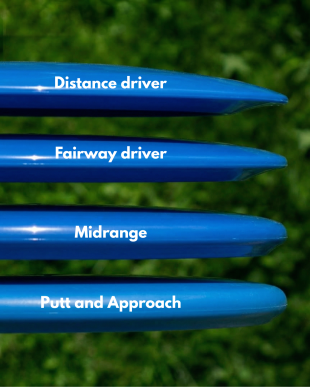
Just as traditional golf uses different clubs, disc golf uses different types of discs. The key physical difference is the rim – wider rims mean faster, longer-flying discs, while narrower rims mean slower, more controllable discs.
| Type | Speed | Characteristics | When to Use |
|---|---|---|---|
| Putter | 1–3 | Deepest profile, thinnest rim (~10mm), blunt edge. Slowest and most controllable. Flies straight. | Putting into basket, short approaches (up to ~60m). Best for beginners. |
| Midrange | 4–6 | Moderate rim (~13–15mm), flatter top. Balance of control and distance. Straighter than drivers. | Approach shots, short drives, tight fairways (up to ~100m). Most versatile disc. |
| Fairway Driver | 7–9 | Wider rim (~16–18mm), sharper edge. Easier to control than distance drivers. | Controlled tee shots, shaping lines (up to ~115m). Good step-up for intermediates. |
| Distance Driver | 10–14 | Widest rim (~20–24mm), sharpest edge. Requires high arm speed and technique. | Maximum distance (100m+). Not for beginners – flies shorter without enough power. |
Flight Numbers Explained
Most discs display four flight numbers describing how they’re designed to fly:
- Speed (1st number): How fast the disc needs to be thrown for its intended flight. Lower = easier to control. For beginners, stick to speed 1–7.
- Glide (2nd number): How well the disc stays airborne. Higher glide = more forgiving for beginners.
- Turn (3rd number): Tendency to curve right early in flight (right-handed backhand). Negative numbers (−1 to −3) = understable = easiest for beginners.
- Fade (4th number): Tendency to hook left at end of flight (right-handed backhand). Lower fade (0–1) = more predictable for beginners.
Key Terminology
| Term | Definition |
|---|---|
| Disc | The flying disc used to play. |
| Basket / Target | Metal chain basket – the ‘hole’ in disc golf. |
| Tee / Tee Pad | Starting area for each hole. |
| Fairway | Playing area between tee and basket. |
| Drive | Long-distance throw from the tee. |
| Putt | Short, controlled throw at the basket. |
| Lie | Where your disc lands – you throw from here next. |
| Par | Expected throws for a skilled player. |
| Ace | Getting the disc in the basket in one throw (hole-in-one). |
| OB | Out of bounds – one penalty throw. |
| Mando | Mandatory gap/path the disc must fly through. |
| CTP | Closest to Pin – a competition format. |
| Backhand | Throw where back of hand faces target. Most common technique. |
| Forehand | Throw where palm faces target. Curves opposite to backhand. |
| X-Step | Footwork to add power to a backhand drive. |
| Hyzer / Anhyzer | Disc angle at release. Hyzer = outside edge down; anhyzer = up. |
| Mini | Small marker disc to mark your lie. |
Rules of Disc Golf
The 5-Step Flow of Play
- Check: Before every throw, check the area ahead is clear. Never throw when there’s any risk of hitting someone.
- Plan: Look at the hole layout. Choose a line that avoids obstacles.
- Tee Off: Take your first throw from behind the tee pad. All players tee off before anyone moves forward.
- Next Throw: Throw from where your disc landed. Player furthest from basket throws next.
- Hole Out: Continue throwing in turn until your disc rests in the basket. Count total throws.
Safety Rules (Non-Negotiable)
- Never throw when there is a risk of hitting someone. This is the number one rule.
- Always wait until all players have thrown before retrieving discs.
- Stand behind the thrower and watch where their disc lands.
- Call out a warning if a disc is heading towards someone.
Gameplay, Penalties & Scoring
Gameplay Rules
- The aim is to complete each hole in as few throws as possible.
- Each throw must be taken from behind the tee (first throw) or behind your lie.
- Players take turns. Player furthest from basket throws next.
- A hole is complete when the disc rests in the basket cage or chains. On top does not count.
- Putts within 10m: maintain balance behind your lie until the disc comes to rest.
Penalties (Simplified)
- Out of Bounds: Add one penalty throw, play from where the disc went OB.
- Lost disc: Add one penalty throw, play from last known position.
- Stuck in tree: Play from directly beneath, no penalty.
Scoring & Spirit of the Game
Each throw counts as one stroke. Lowest total score wins. Scoring terms mirror golf: birdie (one under par), par, bogey (one over). Disc golf is traditionally self-refereed – players call their own penalties and show respect for others. This makes it an excellent tool for developing sportsmanship and integrity.
The ADG Respect Agreement
Australian Disc Golf formalises the spirit of the game through the ADG Respect Agreement, which all ADG members agree to uphold. If you’re familiar with Ultimate’s Spirit of the Game, you’ll recognise the same values here.
The agreement centres on four commitments:
- Respect the game. Play by the rules and follow local regulations wherever you play.
- Respect other players. Treat all players, officials, volunteers, and community members with courtesy – on the course, at events, socially, and online.
- Respect the environment. Be custodians of the spaces where you play. Leave the course better than you found it. Pick up litter, avoid damage to trees and facilities.
- Respect the wider community. In public parks, the public always has right of way. Never throw towards anyone. If someone wanders onto the fairway, walk up and explain the game politely.
These four commitments translate directly into how you should model behaviour as a coach. Your participants will take their cues from you.
Your Duty of Care as a Coach
Before we move on to the quiz, there’s one more concept to understand — and it underpins everything you’ll learn in Modules 2 and 3.
When you coach disc golf — whether it’s a school PE class, a come-and-try day in a park, a disability program, or a club session — you take on a duty of care for every person in your group. That means you are responsible for taking reasonable steps to keep your participants safe from foreseeable harm, both physical and emotional.
What does that look like in practice?
- Physical safety: Checking the venue for hazards before you start. Making sure participants throw in the same direction and never towards each other or bystanders. Using appropriate equipment for the age and ability of your group. Having a plan for what to do if someone gets hurt.
- Emotional safety: Creating an environment where participants feel welcome, included, and respected. Not tolerating bullying, exclusion, or put-downs. Being mindful that some participants — particularly children, young people, and people with disability — may be more vulnerable than others.
- Safeguarding: Understanding your legal obligations when working with children and vulnerable people. This includes holding a current Working with Children Check and completing Sport Integrity Australia’s safeguarding training. You’ll cover these in detail in Module 2.
Duty of care isn’t a separate task you tick off — it’s a lens you apply to every decision you make as a coach, from choosing your venue to how you speak to a participant who’s struggling. It’s the reason this accreditation exists: to ensure that everyone delivering disc golf does so safely and responsibly.
ADG has published a Supplementary Safeguarding Children and Young People Policy that sets out the organisation’s commitment to child safety. As an accredited coach, you are expected to be familiar with this policy and to act in accordance with it.